


The ultimate goal of root canal therapy is for the treated tooth to continue to serve chewing, biting and smiling almost as well as it did before.
However, many patients are less aware that during root canal treatment:
- Removal of decay and the shaping (enlargement) of the root canals inevitably causes significant loss of tooth structure, which means the tooth becomes mechanically weaker.
- After the nerve (pulp) has been removed, the tooth no longer has sensory feedback, so the natural reflex that protects against excessive biting forces is lost.
This combination—structural weakening and loss of sensation—greatly increases the risk of future fracture.
Long-term protection for a root-treated tooth
To minimise the risk of cracking or breaking, most root-treated teeth require definitive coverage after the canal filling:
- Cuspal coverage (such as an onlay, overlay or full crown)
- Reinforces the tooth walls and redistributes chewing forces.
- Especially recommended for posterior (back) teeth and for teeth with large cavities.
- High-quality adhesive restoration
- Even when a crown is placed, using strong bonding materials helps seal the tooth and prevent microleakage.
- Regular check-ups and imaging
- Routine dental examinations and periodic X-rays allow early detection of any hidden cracks or reinfection.
Summary:
A simple filling is rarely sufficient after root canal treatment.
To ensure long-term function and to protect against fracture, the tooth generally needs a cuspal-protective restoration—for example a crown or a bonded onlay—combined with ongoing professional monitoring.

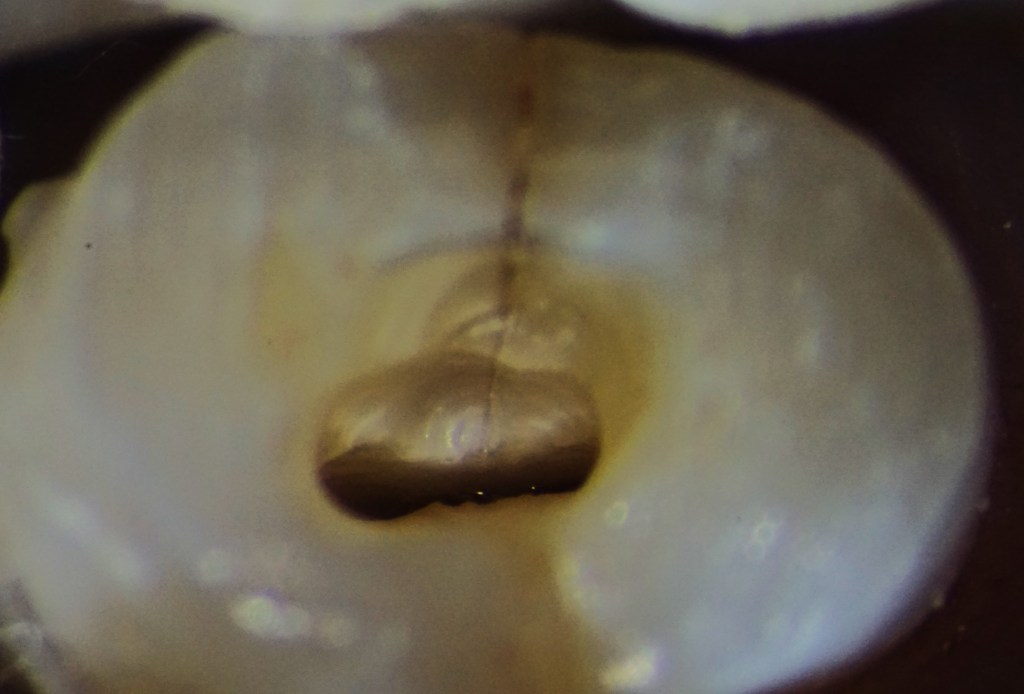
- Tooth cracked along the central fissure
- After opening the pulp chamber of the same tooth, the depth of the crack also becomes visible (unfavourable prognosis)
To prevent a root-treated tooth from cracking or splitting, several protective steps are taken right from the first stages of root canal therapy:
Initial protection
- Bite reduction:
At the start of treatment the tooth is taken “out of occlusion”—the chewing cusps that contact the opposing tooth are reduced by about 1.5–2 mm.
This lowers the risk of further cracking or complete fracture during the treatment phase.
After the root filling
- The dentist evaluates whether a temporary plastic (acrylic) crown is needed for the next 3–6 months to protect the tooth while healing and monitoring continue.
Final restoration for long-term safety
o ensure the tooth remains strong and fracture-resistant in the long run, a definitive cuspal-protective restoration is recommended:
- Full crown (with or without a post)
- A precisely fitting “cap” is bonded over the tooth above the gum line.
- About 1.5–2 mm of tooth structure is reduced from the top and sides.
- If the remaining tooth stump is too short, a post can be placed inside the root canal to provide extra support.
- Suitable for both posterior and anterior teeth.
- Onlay or endocrown
- Depending on the amount of remaining tooth structure, these options can also provide excellent long-term protection against cracks and fractures.
- An endocrown is recommended when there is limited vertical space, meaning the opposing tooth bites too close and a traditional crown would not provide enough bonding surface.
In this case, the walls of the pulp chamber are used to create additional surface area for adhesion.
Endocrowns can be made only for posterior (back) teeth.
3. An onlay is recommended when the root canal treatment has been carried out with minimal loss of tooth structure, but one or both marginal ridges are missing.
It can be made only for posterior (back) teeth.
When is a filling enough?
If the tooth is only slightly damaged, the chewing surface is hardly affected and there is minimal loss of tooth structure, a well-chosen aesthetic filling may occasionally be sufficient—typically in premolars or front teeth.
Summary
- Filling: for small defects, especially in front teeth.
- Cuspal protection (to guard against fracture) with a crown, onlay or endocrown: for large molars or when there is significant loss of tooth structure.
In every case the dentist should decide individually based on the tooth’s condition—
but for long-term safety, protective coverage is usually the more secure option.