

Cutting-edge technology has fundamentally transformed the traditional impression-taking process used for indirect restorations such as crowns, veneers, and inlays/onlays.

With digital impressions, capturing the teeth after preparation (tooth reduction) has become far more comfortable, faster, and even more precise. Following the 3-dimensional scanning of the teeth, all the data are transmitted to the dental technician without any loss of information, in high-resolution, large-format files required for the fabrication of the new restorations.
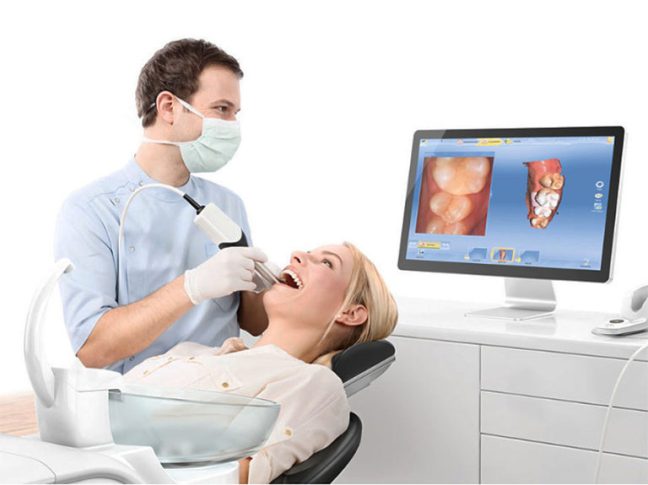
Teeth scanning provides the following advantages compared with conventional impression-taking:
- Suitable even for patients with pronounced gag reflex
- Can be paused or stopped at any time
- No setting time required
- No material running back toward the throat
- Can be evaluated immediately
- Can be easily corrected
- Higher accuracy
- Can be magnified as desired
- Completed in half the time
- The digital impression can be reused for another tooth within three months
- Information is transmitted to the dental laboratory in just a few minutes
For digitally scanned cases, the dental technician can view the prepared tooth at a magnification comparable to that of a dental microscope (about 25×) and use this view to design the planned restoration.