

Inflammation usually brings clear, easily recognisable symptoms—think of the skin: pain, swelling, heat, loss of function.
When we hear the word inflammation, we naturally think of pain.
But is pain always present?
The answer is no.
There are so-called “silent” or hidden inflammations (also known as chronic foci).
How a tooth can become inflamed without pain
In the mouth it is not uncommon that—because of deep decay or trauma—a tooth’s nerve (pulp) dies without any persistent pain, or after only short-lived symptoms that seem to disappear “on their own”.
Once the pulp has died:
- Blood supply stops, and with it the immune defence inside the tooth.
- Bacteria can multiply freely inside the root canal system.
The root canal is not a closed space: small blood vessels and nerves enter and exit through a tiny opening at the root tip.
After the pulp dies, bacteria and their toxins can escape through this opening and create a chronic, often unnoticed inflammation around the root tip.
What forms
A granuloma or cyst may develop around the root apex, visible on an X-ray as a dark spot.
- In its early stage it may be only 1–2 mm.
- Over time it can grow to centimetres, threatening neighbouring teeth, the sinus, or other structures.
This process can remain completely symptom-free, yet it forms a chronic focus of infection that may even contribute to problems elsewhere in the body (e.g. joint pain, hair loss).
Early detection
Regular dental check-ups and routine X-rays every 12–18 months can reveal these hidden inflammations before pain or more serious consequences occur.
Sometimes a 3D CBCT scan is needed for precise diagnosis.
Treatment
To eliminate the source of infection:
- Extraction of the tooth is a quick way to remove the focus, but not the first choice today.
- In most cases the inflammation can be successfully treated with root canal therapy, or if needed, retreatment.
When the root canals are thoroughly disinfected and sealed hermetically, the body can gradually heal the surrounding bone:
the dark lesion on the X-ray usually shrinks and disappears within 1–3 years as the lost bone regenerates.
In short:
A tooth can be seriously inflamed without any pain.
Root canal treatment is often necessary even for a symptom-free tooth to remove the hidden infection and allow full healing.
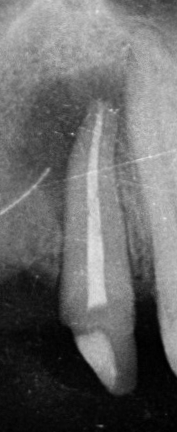

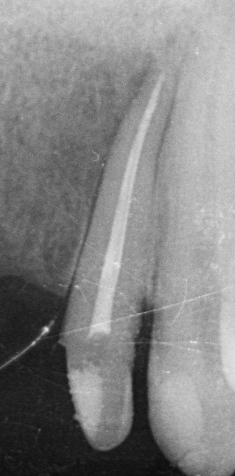
The above X-ray images show snapshots of the healing of a previously non-vital tooth with a chronic infection (“focus”) after root canal treatment:
- at the moment of root filling,
- four months later,
- ten months after the root filling.
It is clearly visible that the “dark spot” around the root tip gradually becomes lighter, meaning that the bone destroyed by the inflammation is regenerating.